

You reach into the freezer, and the bin is empty. Again.
If you own a Samsung refrigerator, you’ve probably been there. The ice maker was humming along just fine, and then one day, nothing. No ice. No noise. Just a frustrating empty bin and a cold drink that isn’t quite cold enough.
Before you call anyone or start pulling the fridge apart, it helps to understand what’s actually going on inside that little module. Once you know how it works, the most common problems start to make a lot more sense.
I’ve repaired hundreds of Samsung ice makers here in Greenville and across the Upstate. In this article, I’m going to walk you through exactly how the mechanism works, how to safely reset it, what typically causes it to quit, and what you can reasonably handle yourself versus what needs a certified technician.
Key Takeaways
- The ice maker is a self-contained cycle. It fills with water, freezes it, warms the tray slightly to release the cubes, ejects them into the bin, and starts over automatically.
- A simple reset fixes a surprising number of problems. Before assuming something is broken, try the test/reset button on the module. It takes about 30 seconds.
- Freezer temperature is the most overlooked cause. Samsung recommends 0°F to 5°F for reliable ice production. Even a few degrees too warm will stall the whole process.
- A clogged or overdue water filter is a top culprit. Samsung recommends replacing the filter every 6 months. A restricted filter starves the ice maker of water pressure.
- Some DIY checks are safe and easy. Verifying the ice maker is turned on, checking the filter, and confirming the freezer temperature are all safe starting points.
- Other repairs require a certified technician. Water inlet valve replacement, ejector motor failure, control board issues, and refrigerant-related problems are not DIY territory.
- Appliance GrandMasters is Samsung factory-authorized. We carry OEM parts and can diagnose and repair your ice maker the same day or next day in Greenville, SC and Western NC.
How a Samsung Refrigerator Ice Maker Actually Works
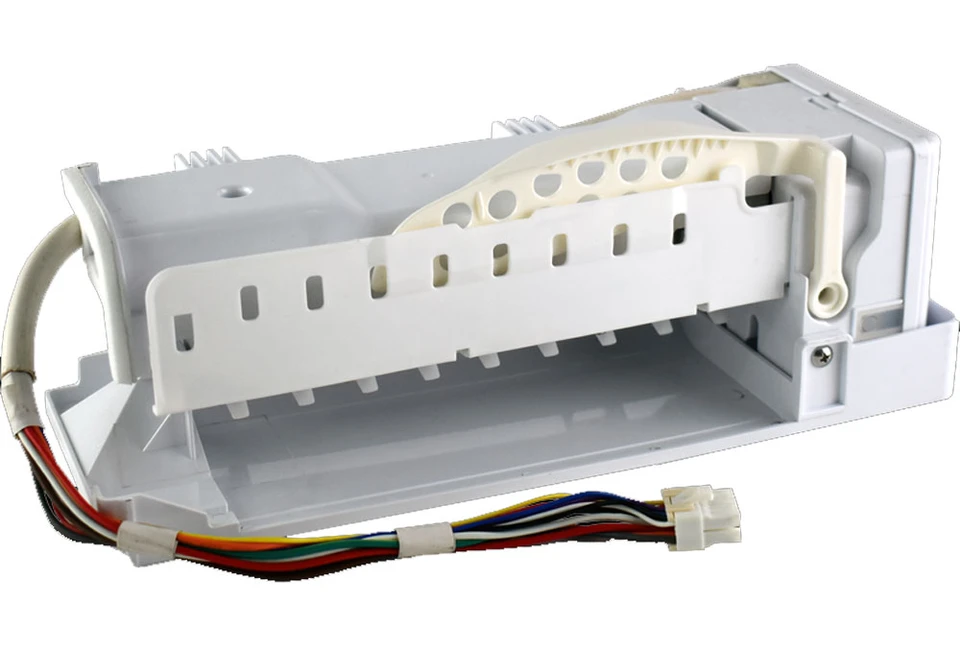
Most people think of the ice maker as one single part. It’s really more like a small automated factory with several components that have to work in the right sequence. If any one of them fails or falls out of sync, the whole process stops.
Here’s a breakdown of every component in the module and what it does.
The Parts Inside the Module
| Component | What It Does |
|---|---|
| Water Inlet Valve | An electrically controlled valve at the back of the fridge that opens for approximately 7 seconds to fill the ice mold with a precise amount of water |
| Ice Mold (Tray) | The compartmentalized tray where water sits and freezes; Samsung uses a flexible or pivoting tray design to help release cubes |
| Built-in Thermostat | Monitors the temperature inside the mold and triggers the next phase of the cycle once the water has frozen solid |
| Heating Element (Coil) | Warms the underside of the mold slightly after freezing, creating a thin melt layer so cubes release cleanly without sticking |
| Ejector Arm and Motor | A motor-driven shaft with blades that rotates and scoops the cubes out of the mold, pushing them through notches in the front of the module and into the storage bin |
| Shutoff Arm (or Sensor) | A mechanical arm or optical sensor that detects when the ice bin is full and halts production until space is available |
| Control Board | The brain of the operation. It coordinates every step, from signaling the water valve to triggering the ejector motor |
The Full Ice-Making Cycle, Step by Step
Understanding the sequence is the key to diagnosing problems. Here’s exactly what happens from start to finish.
- Water fill. The control board sends a signal to the water inlet valve. The valve opens for about 7 seconds, allowing filtered water to flow into the ice mold. The amount is precisely controlled to avoid overflow.
- Freezing. The freezer does the actual work here. The ice maker doesn’t generate cold. It relies entirely on the freezer compartment to bring the mold down to around 10°F to 16°F. Under normal conditions, that takes roughly 90 minutes, according to Samsung’s refrigerator ice maker documentation.
- Thermostat trigger. Once the built-in thermostat reads that the mold has reached the correct frozen temperature, it closes an electrical switch. This is what kicks off the harvest phase.
- Warming and release. The heating coil beneath the mold activates briefly. It doesn’t melt the ice. It just loosens the cubes from the tray walls so the ejector arm can do its job cleanly.
- Ejection. The motor spins the ejector blades. They rotate through the mold, scooping the cubes out and pushing them through the front notches of the module and down into the storage bin.
- Bin level check. As the ejector arm completes its rotation, a cam lifts the shutoff arm. If the bin is full and the arm can’t drop back down, the cycle stops. If there’s room, the arm drops and closes the circuit. The whole process starts over.
The real takeaway here: the ice maker doesn’t make cold; it just manages water and timing. That’s why freezer temperature problems and water supply problems account for the vast majority of ice maker failures.
How to Reset the Ice Maker on a Samsung Refrigerator
This is the first thing I tell every customer before we schedule a service call. A reset clears any stuck cycle the control board may be hung up on, and it works more often than you’d expect.
The good news is it’s completely safe and takes less than a minute.
Find the Reset Button
The location of the reset button varies by Samsung model, but it’s almost always on the ice maker module itself.
- Freezer-compartment ice makers: The button is typically on the front or underside of the module. You may need to remove the ice bin first to access it.
- French door models with an in-door ice maker: Look for a small button on the side of the ice maker housing inside the door.
- Family Hub models: You can also access ice maker settings through the touchscreen display on the door.
If you’re not sure where yours is, check your model number against Samsung’s support documentation for a diagram.
How to Run the Reset
- Remove the ice bin and set it aside.
- Locate the Test/Reset button on the module.
- Press and hold the button for 3 to 10 seconds. You’re waiting for a chime or a click that confirms the cycle has been triggered.
- Replace the ice bin.
- Wait. A single ejection cycle takes about 30 seconds for a freezer-compartment unit and up to 6 minutes for a fridge-door unit. Full ice production resumes over the next several hours.
Important: After a reset, give the ice maker at least 24 hours before deciding it’s still broken. The freezer needs time to get back to the right temperature, and the first full cycle can take longer than normal.
If you run the reset and hear nothing at all, no chime, no motor sound, no water filling, that silence is itself a diagnostic clue. It usually points to a power issue, a failed module, or a water supply problem worth investigating further.
What Causes an Ice Maker to Stop Working?
Samsung ice makers have a reputation for being finicky, and honestly, it’s not entirely undeserved. The design packs a lot of components into a small space, and several of them are sensitive to temperature, water quality, and pressure. Here are the most common culprits I see in the field.
Freezer Temperature Is Too Warm
This is the number one cause I find, and it’s the one homeowners overlook most often.
Samsung requires a freezer temperature between 0°F and 5°F for the ice maker to complete its cycle reliably. Even a few degrees above that range, say 10°F or 12°F, and the thermostat never triggers the harvest phase. The water just sits in the mold and doesn’t freeze quickly enough to keep up with demand.
Check your freezer’s actual temperature with a standalone thermometer, not just the display setting. The display and the real temperature inside can differ, especially if the door seal is worn or the unit is overpacked.
Clogged or Expired Water Filter
Samsung recommends replacing your water filter every 6 months. When the filter gets clogged with sediment, it restricts flow. The water inlet valve may not fill the mold adequately. The result is smaller-than-normal ice cubes, slow production, or no production at all.
This is one of the easiest fixes a homeowner can do. If your filter indicator light is on or it’s been more than 6 months, replace it before anything else.
Ice Maker Is Turned Off
It sounds obvious, but I’ve made service calls where this was the whole issue. Samsung ice makers have a physical on/off switch or a control arm that can get accidentally bumped into the “off” position. On newer models with digital panels, the ice maker can also be toggled off through the settings menu without any obvious visual indicator.
Before assuming a mechanical failure, verify the ice maker is actually enabled.
Ice Buildup and Frost Accumulation
Samsung French door and bottom-freezer models are particularly prone to ice buildup around the ice maker module. When frost accumulates around the mold or the ejector arm, it jams the mechanism entirely.
Common signs of ice buildup:
- You can hear the motor trying to run but no ice drops
- The ice bin is empty despite the motor running
- There’s a visible frost layer around the ice maker housing
This often traces back to a failing defrost cycle, a worn door gasket letting warm air in, or a defrost heater that’s no longer working properly.
Low Water Pressure
The water inlet valve requires a minimum of 20 psi to open and fill properly. If your home’s water pressure is below that threshold, the valve may not open fully, and the mold won’t fill. This can also happen if the water supply valve behind the refrigerator is only partially open.
Faulty Water Inlet Valve
If your water dispenser works fine but your ice maker doesn’t, the inlet valve is a strong suspect. The ice maker port on the valve is separate from the dispenser port. One can fail while the other still works. A failed solenoid inside the valve will stop water from reaching the ice mold entirely.
Ejector Arm or Motor Failure
If you hear the ice maker run through a cycle but no ice comes out, or if the arm appears stuck, the ejector motor or the gear assembly may have failed. Hard water mineral buildup can also jam the arm over time.
Control Board or Wiring Issues
Less common but not rare: the ice maker’s control board can fail, or a wiring harness connection can loosen over time. When this happens, the module loses communication with the refrigerator’s main board, and the cycle never initiates.
Can I Fix My Ice Maker Myself?
Honestly, some things you can absolutely handle on your own. Others you really shouldn’t touch without proper training and tools. I’ll be straight with you about which is which.
Safe DIY Checks You Can Do Right Now
These steps are low-risk, require no tools, and resolve a large percentage of ice maker complaints.
- Confirm the ice maker is on. Check the on/off switch inside the freezer compartment or the settings on the digital panel. If the control arm is raised, lower it to activate production.
- Check and replace the water filter. If it’s been more than 6 months or the filter indicator light is on, replace it. This is a simple twist-and-swap on most Samsung models and requires no tools.
- Verify the freezer temperature. Use a standalone fridge thermometer (available at any hardware store) and confirm the freezer is holding between 0°F and 5°F. If it’s warmer than that, check that the vents inside the freezer aren’t blocked by food items.
- Run the reset. Follow the reset steps in the section above. This clears stuck cycles and is completely safe.
- Check the water supply valve. The small valve behind your refrigerator on the wall should be fully open, not just partially turned. Make sure it’s all the way open.
- Look at the ice bin. Sometimes ice clumps together and forms a solid mass that blocks the shutoff arm, making the machine think the bin is full when it isn’t. Break up any clumps and run a reset.
Quick rule of thumb: If the fix involves checking a setting, swapping a filter, or pressing a button, it’s safe to try. If it involves pulling the fridge away from the wall, disconnecting water lines, or opening any electrical components, stop and call a technician.
What You Should NOT Attempt on Your Own
These repairs involve electrical components, water connections under pressure, or parts that require diagnostic equipment to test properly. Attempting them without training risks injury, water damage to your home, or further damage to the appliance.
- Replacing the water inlet valve
- Testing or replacing the ejector motor or gear assembly
- Diagnosing or replacing the ice maker control board
- Inspecting or repairing wiring harness connections
- Any repair involving the refrigerator’s sealed refrigerant system
- Defrost heater replacement or defrost system diagnosis
When to Call Appliance GrandMasters
You’ve run the reset. You’ve replaced the filter. You’ve confirmed the temperature and checked the water valve. And the ice maker still isn’t producing.
That’s when it’s time to call us.
At Appliance GrandMasters, we’re factory-authorized by Samsung. That means we’re trained directly by the manufacturer to diagnose and repair Samsung appliances using OEM parts. We’re not guessing. We have the diagnostic tools and technical documentation that Samsung provides only to its certified service partners.
Here’s when to pick up the phone:
- The ice maker runs through a cycle but produces no ice
- You hear grinding, clicking, or unusual sounds from the module
- There’s visible ice buildup around the ice maker that keeps coming back
- Your water dispenser works but the ice maker doesn’t
- The reset does nothing, no chime, no motor, no response
- Your Samsung refrigerator is displaying an error code related to the ice maker or freezer
- You’ve already replaced the water filter and verified the temperature, and it’s still not working
We serve Greenville, SC and the surrounding Upstate area, as well as Western North Carolina. Same-day and next-day appointments are available for most ice maker repairs.
Schedule your Samsung ice maker repair: Greenville, SC refrigerator repair | Western NC refrigerator repair
We’ve been recognized as the 2026 UASA Most Professional Servicer, and our technicians are factory-certified by Samsung, LG, Whirlpool, GE, Bosch, and more than 25 other major brands. When your ice maker needs more than a reset, we’re the team to call.
Frequently Asked Questions
How long does it take a Samsung ice maker to make ice after a reset?
After a reset, give the ice maker at least 24 hours before drawing any conclusions. The first cycle can take longer than normal while the freezer temperature stabilizes. Under ideal conditions (freezer at 0°F to 5°F, water pressure above 20 psi), a Samsung ice maker produces a new batch of cubes roughly every 90 minutes.
Why is my Samsung ice maker making ice but not dispensing it?
If ice is forming in the mold but not dropping into the bin, the ejector arm or motor is likely the problem. It could also be a physical jam from an oversized cube or mineral buildup. Check the bin for a solid clump of ice that may be blocking the chute, break it up, and run a reset. If the problem continues, the ejector motor assembly likely needs professional diagnosis.
How often should I replace the water filter on my Samsung refrigerator?
Samsung recommends replacing the water filter every 6 months. If you have well water or water with high mineral content, you may need to replace it more frequently. A restricted filter is one of the top causes of slow or stopped ice production.
What temperature should my Samsung freezer be set to for the ice maker to work?
The freezer should be set to 0°F (-18°C). Samsung’s ice maker mechanism is calibrated to complete its freeze cycle at temperatures between 0°F and 5°F. Anything above 10°F will significantly slow or stop ice production.
My Samsung ice maker is making a loud noise. What does that mean?
Grinding or clicking sounds during a cycle usually point to the ejector arm struggling against a jam, worn gears in the motor assembly, or ice buildup interfering with the mechanism. Don’t ignore it. Running the motor against a jam repeatedly can cause the gear assembly to strip. If a reset and clearing the bin doesn’t resolve the noise, have a technician inspect the module.
Can a Samsung ice maker be repaired, or does the whole module need to be replaced?
It depends on what failed. Individual components like the water inlet valve, ejector motor, or heating element can often be replaced without swapping the entire module. In some cases, replacing the full ice maker assembly is more cost-effective. That’s especially true with older units or widespread internal damage. A certified Samsung technician can diagnose which repair makes more sense for your specific model.
The Bottom Line
A Samsung ice maker is a well-engineered piece of equipment when everything is working the way it should. The most common failures aren’t mysterious; they trace back to temperature, water supply, or a simple stuck cycle that a reset can fix in under a minute.
Start with the basics: confirm it’s on, check the filter, verify the temperature, and run the reset. You’ll resolve the problem more often than you’d think.
But when those steps don’t move the needle, the remaining issues, valve failures, motor problems, control board faults, and defrost system failures, require the right diagnostic tools and factory training to fix correctly. Attempting those repairs without proper knowledge risks making the problem worse or causing water damage to your home.
That’s what we’re here for. If your Samsung refrigerator ice maker still isn’t working after the safe checks above, contact Appliance GrandMasters and we’ll get a certified technician out to you, usually the same day or next day.