
You’re not alone. Here in Greenville, we see this all year: dryers that tumble just fine but refuse to get hot, or ones that kind of heat but take forever to dry a single load. And a lot of the time, the dryer itself isn’t the only problem — the house, the vent, the washer, and even our Upstate humidity all team up against you.
In this guide, I’ll walk you through why dryers stop heating, what you can safely check yourself, and when it’s time to tag in a professional so you don’t risk your home, your appliance, or yourself.
Some fixes look simple on YouTube. That doesn’t mean they’re risk-free.
Any time you mess with a dryer, there are real dangers:
This article is for education, not a promise that any repair is safe in every situation. You’re responsible for your own safety and decisions. If you ever feel unsure, that’s your cue to stop and call a professional technician.
Before you touch anything, slow down. A few minutes of prep saves a lot of trouble.
First thing, kill the power. For an electric dryer, that means unplugging it from the wall. If you can’t reach the plug, shut off the breaker — both poles of the 240V breaker, not just one side. With gas dryers, shut off the gas valve if you’re going to move the unit or work near the burner area.
Give the machine a moment to sit. Internal components can stay hot for a while, especially around the heating element or gas burner. Let it cool down so you’re not reaching into a hot metal box.
When you move the dryer, go easy. Don’t yank it forward so hard that you crush or tear the vent behind it. The vent is your lifeline for airflow; damaging it makes everything worse and more dangerous.
If you do remove any covers that expose wiring or burners, that’s already “borderline pro” territory. If you find yourself staring at wires, control boards, or gas tubing and you don’t instantly know what you’re looking at, that’s a sign to step back and call someone who does this every day.
And finally, never bypass a safety device just to “get it running.” Thermal fuses, high-limit thermostats, and flame sensors exist so your house doesn’t catch fire.
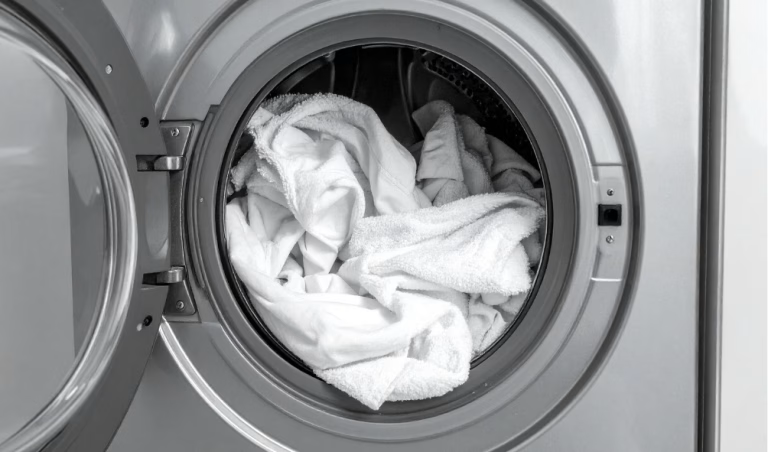
To understand why a dryer won’t heat, you need a simple picture of what’s happening inside.
In an electric dryer, power comes in on two 120V “legs.” Together they make 240V. That 240V feeds a big resistive coil called the heating element. Electricity flows through that coil, it gets red hot, air blows over it, and that hot air goes through the drum and out the vent.
If the coil breaks, no current, no heat. If only one side of the 240V breaker trips, the motor still runs on 120V, but the element never gets full power — so it tumbles, but it’s cold.
In a gas dryer, the sequence is a little more dramatic. The igniter heats up and glows, a flame sensor watches that heat, and gas valve solenoids open to let gas flow when everything checks out. The burner lights, heats the air, and the blower moves hot air through the drum. If the igniter glows but no flame, or the flame dies quickly, you’re likely dealing with bad solenoids, a dirty burner, or a sensor issue.
Both types rely on good airflow and safety controls. If things get too hot, safety thermostats and thermal fuses will cut power to the element or burner to prevent a fire. That’s good for you… but it shows up as “no heat.”
Let’s break it down into a few big buckets.

This is what most people think of first — broken parts.
Common internal issues include:
These usually require tools and testing. In my own work, I don’t replace elements or thermostats without checking airflow and vents first — otherwise, you just burn out the new parts again.
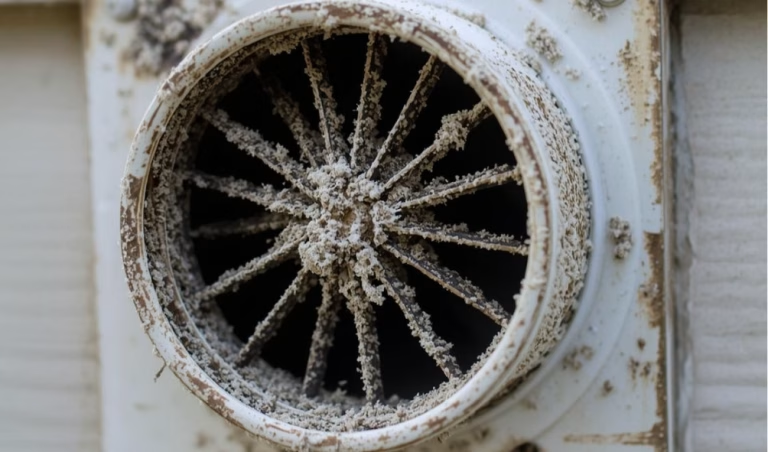
Here in Greenville, the house and vent setup cause a huge percentage of “no heat” or “poor heat” complaints.
Examples:
To the homeowner, all of this looks the same: “My dryer isn’t heating.” Underneath, the machine might be begging for help because it can’t move air.
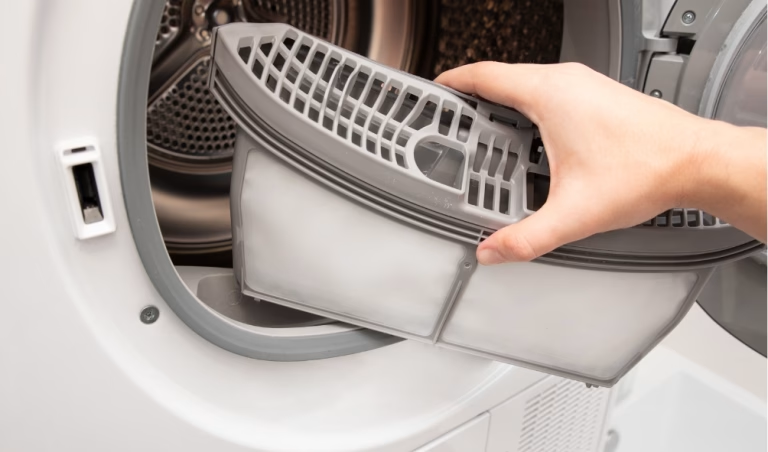
Sometimes the dryer is taking the blame for something upstream.
I’ve been to homes where the real issue was:
From the owner’s point of view, it’s just “dryer not heating.” In reality, the system as a whole isn’t working well.
Here are some homeowner-friendly checks that usually don’t require tools and can be done safely if you follow the safety steps above.
If these simple steps improve the situation, your dryer was probably choked more than broken. If nothing changes, it’s time for deeper diagnostics.
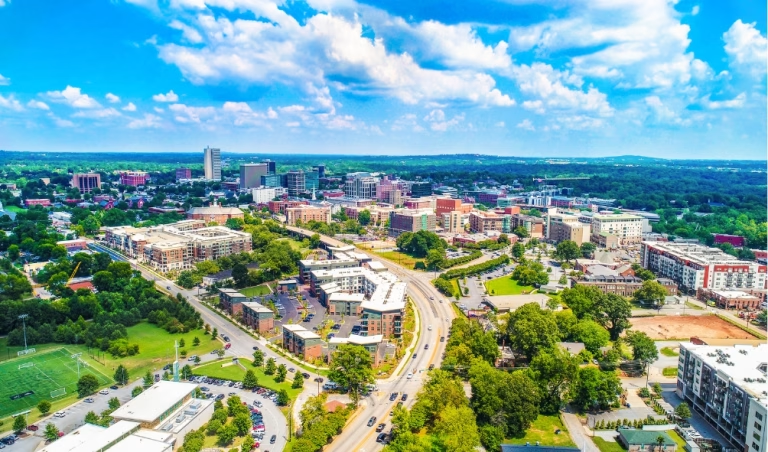
Dryers in Upstate South Carolina don’t live an easy life.
In the summer, the air coming into the dryer is already warm and humid. That air can’t hold much more moisture, so the dryer has to run longer to evaporate water from your clothes. People often think, “It’s not heating like it used to,” when the real problem is the air itself is too wet and heavy.
In winter, the opposite happens in the vent. Hot, moist air leaves the dryer, hits a cold metal pipe in an unconditioned attic or crawlspace, condenses, and forms that lint-sludge mixture I mentioned earlier. Eventually, that builds up so much that heat can’t escape, fuses blow, and elements overheat and fail.
Add in bird nests, squirrels, and mice using vents as condos, and you can see why “dryer not heating” searches are so common around Greenville.
Here’s where I draw the line as a tech when advising homeowners.
You should call a professional if:
A qualified technician in Greenville won’t just swap parts. They’ll:
Yes, there’s a diagnostic fee. But that fee buys you a clear answer, a safe fix, and no guessing with 240V power or gas.

Why does my dryer run but not heat at all?
Most of the time it’s a burned-out element, blown thermal fuse, or a 240V power problem (one leg of the breaker tripped). Sometimes it’s a totally blocked vent causing safety devices to open.
Can a clogged vent really cause “no heat”?
Absolutely. Poor airflow overheats the dryer internally. Safety thermostats and fuses shut down the heater to prevent a fire, and the dryer ends up running cold.
Is it safe to replace a dryer heating element myself?
Mechanically, some people can do it. Electrically and safety-wise, it’s not a beginner job. You’re working around 240V, sharp metal, and in some cases, lots of hidden lint. If you’re not experienced, I consider that pro territory.
How often should I have my vent professionally cleaned in Greenville?
With our humidity, typical family use, and long vent runs in many homes, once a year is a good rule of thumb — more often if you see slow drying or have lots of lint at the outside hood.
Could the problem be my washer, not my dryer?
Yes. If clothes come out of the washer dripping instead of damp, the dryer will struggle even if the heater is perfect. A weak spin cycle or drain issue in the washer can easily be the hidden cause.
A dryer that’s not heating can drive you crazy, but it doesn’t always mean you need a new machine. In Greenville, I see just as many airflow, vent, and humidity issues as I do “dead parts.”
A few safe checks — clean filter, good vent airflow, clear outside hood — are worth doing. If those don’t fix it, or anything feels risky, that’s when bringing in a professional isn’t a luxury, it’s the safest move.
If your dryer in Greenville or the surrounding Upstate area is running cold, taking forever, or acting weird, we can help you figure out whether it’s a simple airflow fix, a bad heater, or a house-side issue nobody has spotted yet.
Need help with a dryer that’s not heating?
You can schedule service with Appliance GrandMasters through our website and we’ll send an experienced technician who actually understands how Greenville’s climate and vent setups affect your dryer.
Don’t stress. Appliance GrandMasters provides professional appliance installation and repair services to keep your appliances in top condition. Let our skilled technicians handle the work, ensuring your appliances run smoothly and efficiently. Contact us today for all your appliance repair needs in Greenville.
Get professional home appliance Repairs, maintenance & Installation now!
No worries! We’ve got you covered.
At Appliance GrandMasters, we’ve got your back. Let the experts handle it, so you can enjoy the convenience of smoothly running appliances without the DIY stress.
Our Appliance Repair & Maintenance Service Area
Greenville, Greer, Taylors, Simsponville, Mauldin, Easley, Pickes, Liberty, Pelzer, Williamston, Spartanburg, Honea Path, Belton, Piedmont, Travelers Rest, Wellford, Fountain Inn, Moore, Reidville, Duncan, Lyman, Boiling Springs, Inman, Campobello, Landrum
Formerly known as Mr. Rogers Appliances, we rebranded our appliance repair company to Appliance GrandMasters in June 2020. Since then, we have focused on developing our brand to be customer-oriented.
Fixing appliances has become a passion for us. We enjoy challenges, and we are always preparing and updating ourselves to become the very best.
We accomplish swift and top-notch service by employing efficient and friendly customer service procedures that guarantee accurate answers and solutions.
Our approach involves the careful selection and comprehensive training for the necessary skills to fulfill our customers’ needs. Through these strategies, we strive to consistently provide exceptional service.