
Trust me, you’re not alone. Dryer no heat? Washer not draining? Those searches spike constantly here in Greenville. A lot of people like to try a few things on their own first, and that makes sense — if you can solve a simple problem in five minutes, why not?
At the same time, local appliance companies (including us) send trained techs out with loaded vans, specialized tools, insurance, and years of experience. We charge a flat diagnostic or trip fee. That fee isn’t “just for showing up” — it covers the time, fuel, and expert testing needed to tell you exactly what’s wrong and what your options are.
So the sweet spot is this:
This article breaks down the most-searched DIY repairs, the real error codes behind them, why smart washers still choke on basic old-school problems, and when it’s safe to attempt a fix… and when it’s smarter to lean on a pro.
A few safe 5-minute checks can save you a service call — and when those don’t work, a professional diagnosis is worth every penny.

Some of the fixes we talk about here are simple. They seem easy. And many homeowners in Greenville do them successfully. But there are always risks:
A few important rules before you try anything:
This guide is for educational purposes only, not a guarantee that a repair will be safe or successful in every situation. You’re responsible for your own safety and for deciding when it’s time to bring in a trained technician. When in doubt, don’t risk your home, your appliance, or yourself.
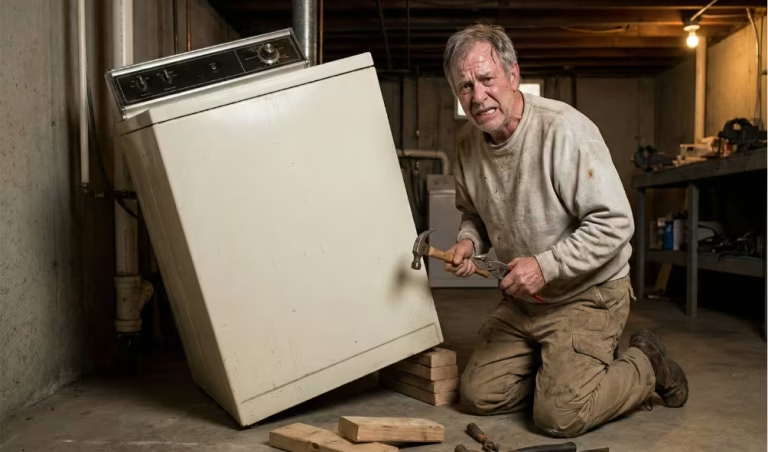
Most homeowners are pretty handy. They don’t mind rolling up their sleeves for a few minutes, especially if the problem might be simple, like a clogged filter or a tripped safety device.
On top of that, service companies typically charge a diagnostic fee. Around here, that usually falls in the same range as a decent night out — and it includes:
So a lot of people think:
“If I can fix this with a quick reset or filter clean, I’ll try that first. If not, I’ll let the pros take it from there.”
That’s exactly how this article is written — start with simple, safe things you can try, and if they don’t solve it, that’s your sign a professional visit will be money well spent.
These codes show up constantly across Whirlpool, LG, Samsung, GE, Speed Queen, and Electrolux:
Different letters, same meaning: “I can’t drain, something’s in my way.”
All of these say: “I’m supposed to fill, but I’m not getting water.”
And underneath all of that “smart” language? It’s usually simple stuff: clogs, hoses, or a comforter wadded into a ball.
Your washer might talk to your phone and show fancy graphics, but most failures are not “tech” problems. They’re flow problems.
Codes like OE, 5C, E23, and F9 E1 all basically translate to:
“Water isn’t leaving the tub fast enough.”
That’s usually:
This is why DIY repairs often work here — you’re not rewriting software. You’re clearing a pathway.
This is one of the most common problems searched online. In a lot of cases, the dryer runs, tumbles, but never gets warm. Often the culprits are:
For brands like Samsung, heating elements are common failure points, and replacements are generally affordable. I’ve seen local homeowners in Greenville swap a bad element for a new one in under an hour after watching a single tutorial.
And here’s where the value of expertise comes in:
a qualified tech can test live voltage, airflow, and internal components safely. That diagnostic fee covers years of electrical and safety training you don’t have to gamble with yourself.
This is the DIY king around here.
Common signs:
Nine times out of ten, I pull out:
A few local companies even show customers how to clean this filter because it’s so simple once you know where it is.
When it goes wrong — say the pump impeller is broken, wiring burned, or the control board isn’t sending power — that’s when the tech visit goes from “extra cost” to huge time and stress saver.
A frosted coil acts like a blanket. No air moves. Temperatures climb. The sealed system thinks it’s losing refrigerant when it’s actually suffocating.
Those little mesh screens behind your washer hoses catch debris. Over time, even in soft-water Greenville, they can plug up.
Quick check:
If that doesn’t solve a fill code like 4C/4E or IE, then you might be looking at a bad inlet valve, control issue, or wiring fault. That’s where the diagnostic visit earns its keep.
Big items (comforters, blankets, heavy towels) like to clump. The machine freaks out. LG UE, Speed Queen Ub, shaking, loud banging, the whole drama.
You can usually fix it by:
If, even with small loads, the machine constantly errors out or walks across the floor, then we’re in “suspension, shocks, or control logic” territory. That’s where a tech’s experience pays off, because they can tell in minutes whether it’s wear and tear or something deeper.
So many people think their dryer is dying when it’s just the vent.
Typical signs:
A clogged vent stresses the dryer, wastes energy, and shortens the life of key parts. A decent vent brush kit can work wonders. But if the duct is long, goes through a crawl space, or you’re not comfortable pulling the unit out, hiring someone to clean or inspect the duct is often money well spent.
Three local realities:
Greenville’s soft water means detergent foams faster. Too much soap → too much foam → drain errors and clogged filters.
Cold fill lines under the house can slow detergent dissolving, creating residue and partial clogs.
Moist, warm spaces (like filter housings and pump areas) grow slime faster here.
That’s why flow issues are the top villains — not “smart tech failures.”
Should I try the 5-minute fixes before calling a tech?
If they’re simple, non-electrical checks (filters, hoses, screens, load balance), yes. They’re safe and often effective. Anything beyond that, especially involving wiring, heating parts, or internal disassembly, should be handled by a professional.
What does a diagnostic fee actually pay for?
It covers the trip to your home, professional tools, live testing, and an expert diagnosis so you’re not guessing. Many companies apply it toward the repair if you move forward.
How do I know when to stop DIY?
If you see sparks, smell burning, hear grinding, feel unsure, or you’re about to open panels you don’t understand — stop. That’s what trained techs are for.
Why does my washer keep showing the same drain code?
Because the underlying flow issue isn’t fully resolved — either the filter, hose, pump, or excessive suds are still a problem.
Can I damage the machine by trying too many DIY things?
Yes, if you start disconnecting internal parts or guessing with electrical components. Stay on the safe side: stick to external, clearly designed-for-user areas only.
Washer and dryer DIY fixes don’t have to be scary. For a lot of Greenville homeowners, clearing a filter or replacing a simple part is totally doable and can save time and money.
But there’s a point where guessing becomes more expensive — and riskier — than a professional diagnosis. That’s when that diagnostic fee stops feeling like a cost and starts feeling like insurance — a clear answer from someone who does this every day and knows how to keep you and your home safe.
If your washer or dryer keeps throwing codes, refusing to heat, or flooding the floor, we can help you figure out whether it’s a quick fix or a deeper sealed system, control, or motor issue.
Schedule appliance repair with Appliance GrandMasters
Don’t stress. Appliance GrandMasters provides professional appliance installation and repair services to keep your appliances in top condition. Let our skilled technicians handle the work, ensuring your appliances run smoothly and efficiently. Contact us today for all your appliance repair needs in Greenville.
Get professional home appliance Repairs, maintenance & Installation now!
No worries! We’ve got you covered.
At Appliance GrandMasters, we’ve got your back. Let the experts handle it, so you can enjoy the convenience of smoothly running appliances without the DIY stress.
Our Appliance Repair & Maintenance Service Area
Greenville, Greer, Taylors, Simsponville, Mauldin, Easley, Pickes, Liberty, Pelzer, Williamston, Spartanburg, Honea Path, Belton, Piedmont, Travelers Rest, Wellford, Fountain Inn, Moore, Reidville, Duncan, Lyman, Boiling Springs, Inman, Campobello, Landrum
Formerly known as Mr. Rogers Appliances, we rebranded our appliance repair company to Appliance GrandMasters in June 2020. Since then, we have focused on developing our brand to be customer-oriented.
Fixing appliances has become a passion for us. We enjoy challenges, and we are always preparing and updating ourselves to become the very best.
We accomplish swift and top-notch service by employing efficient and friendly customer service procedures that guarantee accurate answers and solutions.
Our approach involves the careful selection and comprehensive training for the necessary skills to fulfill our customers’ needs. Through these strategies, we strive to consistently provide exceptional service.